
Courage amid injustice
BACKGROUND
The 100th and 442nd served with distinction in Europe while many Japanese American families were confined by the U.S. government. Their military service and the injustice at home must be studied together.
Before the 442nd
Japanese Americans were serving in the U.S. military before Pearl Harbor. After the attack, the government questioned their loyalty because of ancestry. On the West Coast, more than 120,000 people of Japanese ancestry were forcibly removed and incarcerated; many were U.S. citizens. The military restricted Japanese American enlistment. These policies were government choices, not evidence that Japanese Americans had done anything wrong.
In Hawai‘i, Japanese American National Guard soldiers formed the 100th Infantry Battalion in 1942. The 100th trained on the mainland and went to Italy in 1943. In 1943 the Army created the segregated 442nd Regimental Combat Team, composed of Japanese American enlisted men with predominantly white officers. Volunteers came from Hawai‘i and the mainland, including incarceration sites. The 100th and 442nd had distinct beginnings; the 100th later joined the 442nd while retaining its name.
What service meant—and what it did not
Some Japanese Americans volunteered to demonstrate loyalty and claim the rights of citizenship. Others challenged the draft or refused service while families remained incarcerated. Those choices arose from different circumstances and principles. Neither choice should be erased to turn the story into a simple test of patriotism. Soldiers from Hawai‘i and the mainland also had different experiences of exclusion and incarceration.
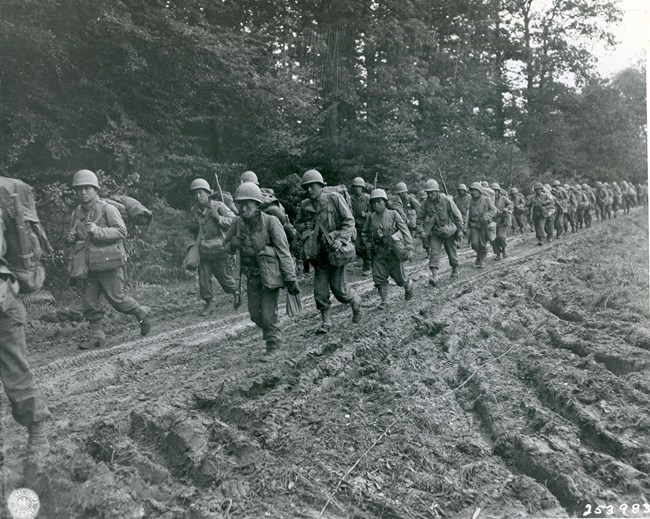
The 100th/442nd fought in Italy and France. Infantry, artillery, medics, engineers, and support personnel made the unit work. In the Vosges Mountains in October 1944, the 442nd helped rescue an encircled Texas unit remembered as the “Lost Battalion.” The rescue succeeded at a severe cost to the Japanese American soldiers. Later, the 100th/442nd returned to Italy. The 522nd Field Artillery Battalion, originally part of the 442nd, helped liberate prisoners from Dachau subcamps in 1945. Be precise about the subcamps rather than claiming this unit alone liberated the main camp.
After the fighting
The soldiers received major honors, but decorations did not immediately end discrimination against Japanese Americans. Families returned from incarceration to lost property, hostile neighbors, and a fight for redress. A fuller history links battle reports to family letters, incarceration records, and testimony from people who disagreed about serving. It also asks why a nation celebrated soldiers while violating the rights of their relatives.
Words in context
- Nisei
- U.S.-born children of Japanese immigrants; many soldiers in the 100th/442nd were Nisei.
- segregated unit
- A military unit organized separately by race or ancestry under a discriminatory system.
- incarceration
- Government confinement; this term describes the forced confinement of Japanese Americans during the war more accurately than the euphemism “relocation.”
- redress
- An effort to acknowledge and remedy an injustice, including the later movement for a federal apology and compensation.