English is available throughout DecisionPoint. Other languages currently support the language menu and selected study guidance. Chrome translation can help with the rest.
Use this original tab to answer questions and access saved work.
UNSUNG HEROES · SERVICE · MEMORY
Who kept the war effort moving?
Follow soldiers, workers, communicators, and resisters beyond the best-known commanders. Compare what they contributed with the barriers they faced and how they were remembered.
DEEP STUDY
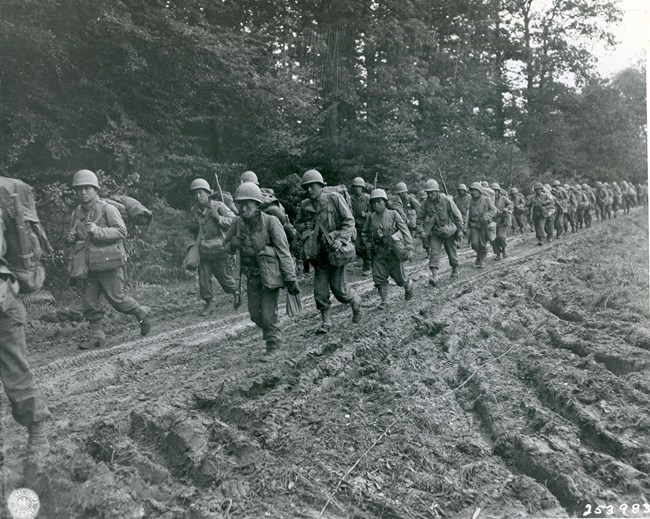
The 100th and 442nd
Japanese American soldiers fought in Italy and France while many families were incarcerated by their own government. Trace the distinct beginnings of the 100th Battalion, the formation of the 442nd, the Lost Battalion rescue, the 522nd Field Artillery Battalion, and the long struggle for recognition and redress.
442nd soldiers in France, October 1944. National Archives photo via National Park Service.
FOUR WAYS TO SERVE
Logistics and communication are part of the story
MAIL · EUROPE · 1945
The 6888th Central Postal Directory Battalion
This all-Black, all-female Army unit tackled a huge backlog of undelivered mail in Britain and France. The women organized an around-the-clock sorting operation while facing segregation, racism, and sexism. Mail carried news from home and helped sustain morale; the work was logistical and human.
After the Normandy breakout, the Allied advance outpaced its fuel and ammunition. The Red Ball Express used a one-way truck route to keep supplies moving. Black soldiers made vital contributions as drivers, mechanics, and loaders within a segregated Army. Their work connected the beachhead to the front.
Navajo Marines used an oral code in Pacific operations. The National Archives also documents code talkers from other Native nations, including Kiowa, Hopi, Creek, and Seminole people. Each language, unit, and theater has its own story; avoid treating all code talkers as one interchangeable group.
A contribution is more than combat. Follow labor, logistics, intelligence, resistance, and political demands for recognition.
Indian Army and the Burma campaign
Millions served in the British Indian armed forces during the war, in North Africa, Italy, and Asia. The Burma campaign connects Indian soldiers, local communities, African units, British forces, Chinese forces, and the fight over supply routes. Ask whose service appears in a map caption and whose does not.
Soldiers recruited across French and British colonial territories served in Africa, Europe, and Asia. Some fought to liberate France while colonial inequalities persisted. Compare recruitment, command, recognition, and postwar demands for rights rather than treating all colonial service as one experience.
The Tuskegee Airmen, 761st Tank Battalion, and 6888th Central Postal Directory Battalion are starting points for studying skilled service within a segregated military. At home, workers challenged discrimination through the Double V campaign.
Navajo Marines developed and used a code in the Pacific; people from other Native nations also served as code talkers in World War II. Study the specific language and unit rather than assuming one shared Native experience.
Women served as pilots, medics, snipers, partisans, and industrial workers. Civilians sustained production and survived siege and occupation. Study those contributions with the enormous military and civilian losses of the Soviet war.
A British Special Operations Executive agent of Indian heritage, Khan operated a radio in occupied Paris in 1943 even after her network was compromised. She was captured and murdered at Dachau.
Investigate: What did clandestine communication make possible, and what risk did the operator bear?
The all-Black, all-female 6888th Central Postal Directory Battalion cleared backlogs of military mail in Britain and France. Their logistical work connected service members to home while they faced racism and sexism.
Investigate: Why is mail delivery a military contribution during a long war?
As a Japanese vice consul in Lithuania in 1940, Sugihara issued transit visas to Jewish refugees seeking a route to safety. A visa did not guarantee survival; investigate the larger journey and the other governments involved.
Investigate: How much could one official decision change, and what limits remained?
Pilecki entered Auschwitz as a prisoner in 1940 and organized a resistance network that gathered information about conditions and Nazi crimes. His reports must be read alongside other evidence and the changing nature of the camp.
Investigate: How could information escape a camp, and who was able to act on it?
Choose two people or groups from different fronts. Compare the barrier they faced, their specific contribution, and how later accounts recognize them. Name one question the available source cannot answer.