Document · July 25, 1945Written before August 6
Truman's private diary
Truman wrote about avoiding women and children and using the bomb on military targets. Compare intention with actual city effects.
Ask the source: Where do intention and outcome diverge?
What it cannot prove: One diary entry does not establish what everyone understood about targeting.
Object · August 1945Date each leaflet separately
Warning leaflets as objects
The Truman Library holds leaflets dropped on Japanese cities in conjunction with the bombings. Inspect dates and named cities.
Ask the source: Who was warned, about what, and when?
What it cannot prove: A surviving leaflet does not prove when a particular city received a warning or that it described the atomic weapon.
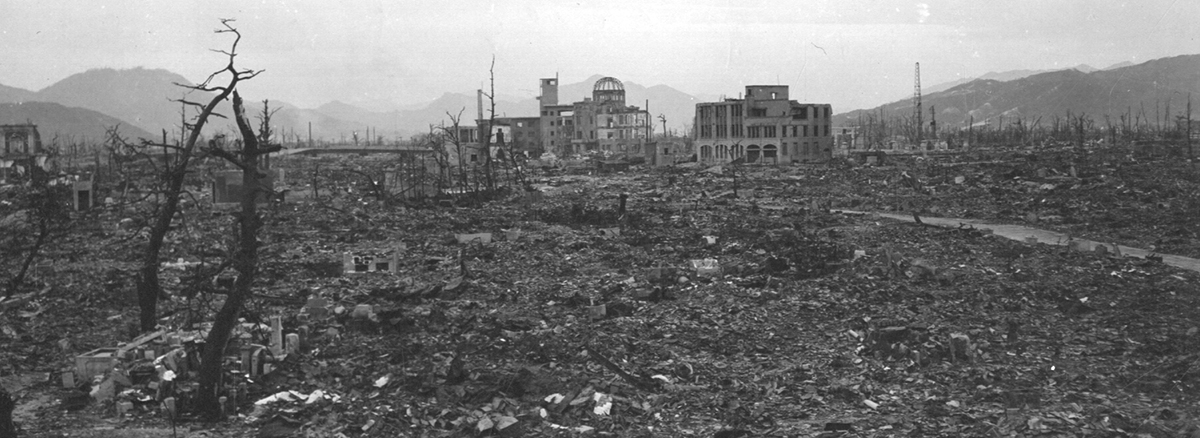
Photograph · 1945 aftermathVisible after August 6
Hiroshima from the air
National Archives photographs show widespread damage to the cityscape after the bombing.
Ask the source: What can you see directly, and what requires another source?
What it cannot prove: An aerial view does not show people's full experience or an alternative future.
Photograph · 1945 aftermathVisible after August 9
Nagasaki damage photographs
Ground and aerial photographs were used in postwar assessments of Nagasaki's destruction.
Ask the source: What does a ground view show that an aerial view misses?
What it cannot prove: A damage survey does not show every injury or the leaders' reasoning.
Film · 1945 footageFilmed after the attacks
Archival film of the effects
National Archives links to post-bombing footage and wartime film. Distinguish what the camera records from narration.
Ask the source: Which details are footage and which are interpretation?
What it cannot prove: Edited film reflects a producer's purpose and selection of scenes.
Testimony · Recorded 1986Survivor memory recorded later
Yoshitaka Kawamoto, age 13
A Hiroshima Peace Memorial Museum video with English subtitles recounts one school student's experience near the hypocenter.
Ask the source: What does this reveal that a map or memo cannot?
What it cannot prove: Personal memory documents experience but cannot alone determine leaders' options.
Testimony · Recollection recorded laterSurvivor memory recorded later
Sakue Shimohira remembers Nagasaki
A person who was ten during the attack describes wartime life and the bombing's continuing impact.
Ask the source: What long-term effects does a casualty estimate miss?
What it cannot prove: One testimony cannot speak for every resident or predict an alternative strategy.
Map · August 8–9, 1945Entry during the crisis
Soviet invasion of Manchuria
The Soviet Union declared war and attacked Japanese-held territory, changing the military and diplomatic situation.
Ask the source: Which simultaneous events make a single-cause claim hard?
What it cannot prove: The sequence does not prove the relative weight of Soviet entry and the bombings.
Document · August 7–9, 1945Internal discussions translated later
Japanese cabinet discussions
Translated records show debate about surrender after Hiroshima and then Soviet entry, including disagreement among leaders.
Ask the source: Who wanted which terms, and when?
What it cannot prove: An account of meetings is not a single unified national response.
Document · August 14–15, 1945Reconstructed afterward
Resistance to surrender
Some Japanese officers tried to prevent the emperor's surrender message from being broadcast.
Ask the source: What does this show about implementing surrender?
What it cannot prove: A coup attempt does not prove every leader favored continuing war.
Data · 1946Postwar conclusion
Strategic Bombing Survey judgment
A U.S. postwar survey argued Japan likely would have surrendered before an invasion without the atomic bombs. Historians debate this conclusion.
Ask the source: What evidence and assumptions support its prediction?
What it cannot prove: A retrospective inference was not certain knowledge available in July 1945.
Document · 1945 records, assembled laterCurated afterward
Compare original documents
A collection brings together orders, intercepted messages, memoranda, Japanese accounts, and later recollections.
Ask the source: Which two sources disagree, and why?
What it cannot prove: A curated set reflects selection and translation; distinguish original text from editorial framing.