

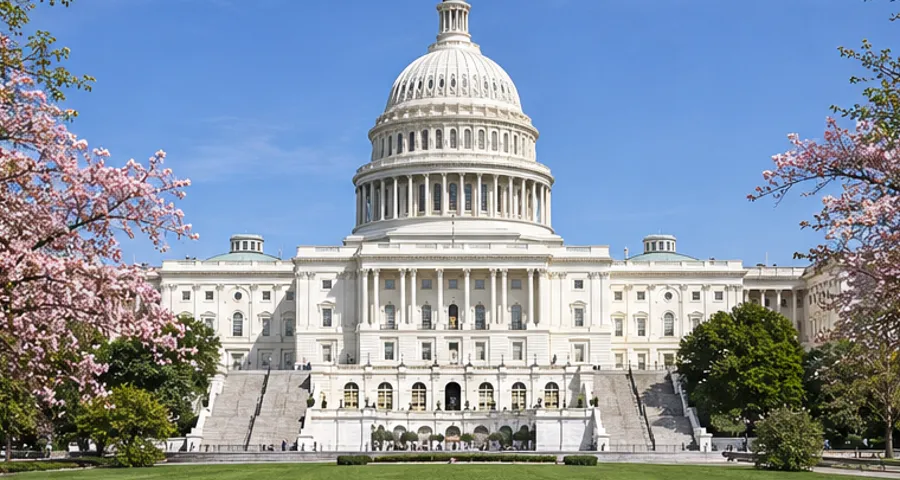
Bill-to-law notes · The House
1. An idea enters the House
Anyone can suggest an idea for a law: students, citizens, interest groups, experts, or the president. A member of Congress must officially introduce a bill in that member’s chamber. A bill is a proposed law. A law is a proposal that has completed the required process. In the House, bills use the prefix H.R. The House has 435 voting seats.
Most bills can begin in either chamber. Bills for raising revenue must begin in the House, although the Senate may amend them. The House and Senate can also work on related proposals at the same time. The process is a set of gates rather than one automatic conveyor belt.
After introduction, a bill is referred to a committee with expertise in its topic. Referral means sending it to that committee. In hearings, members gather evidence and listen to witnesses. During markup, they debate the bill’s wording and may revise it through amendments. A committee may report a bill to the chamber, reject it, or take no action. Many bills stop here.
Getting out of committee does not guarantee a floor vote. House leadership controls much of the schedule. For many major bills, the Rules Committee proposes a special rule governing debate time and which amendments may be offered. The full House must adopt that rule. Final passage of ordinary legislation usually requires a majority of votes cast, with a quorum present.
- CommitteeReview, revise, or decline to advance the proposal.
- First chamberDebate and vote on a version.
- Second chamberAct on the bill, possibly changing its wording.
- AgreementBoth chambers approve identical text.
Keep this distinction: Idea → introduction → committee work → possible floor action. Committee approval is one gate, not the finish line.
Bill-to-law notes · The Senate
2. The Senate: debate, cloture, and passage
The Senate has 100 seats. A senator introduces a Senate bill, which uses the prefix S. Revenue-raising bills must originate in the House; the Senate can consider and amend a House revenue bill. Senate committees also use referral, hearings, markup, and reporting to examine proposals.
Senate debate rules make delaying a vote possible on many legislative questions. A filibuster is action designed to prolong debate and delay or prevent a vote. It does not always involve one senator speaking continuously. The threat of extended debate can affect negotiations and scheduling.
Cloture is the procedure used to limit debate. For most legislation, invoking cloture requires three-fifths of senators duly chosen and sworn, normally 60. Cloture does not itself pass the bill. Further consideration and a separate final-passage vote may follow. Ordinary final passage generally needs a simple majority, with a quorum present. Special procedures, including certain budget measures, can limit debate differently. Nomination rules also differ from the usual legislative cloture rule.
Keep two questions separate: “Can the Senate get to a final decision?” and “Will the bill pass at the final vote?” A proposal may have enough supporters for ordinary passage but too few to invoke cloture when a filibuster blocks progress.
Keep this distinction: Cloture limits debate. Final passage approves a bill. They are different decisions.
Bill-to-law notes · The Final Gates
3. Agreeing on a bill and presidential action
Both chambers must approve the same bill in identical form. If the House approves $100 million for a program and the Senate approves $80 million, they have not finished. They may exchange amendments or use a conference committee to negotiate. Both must approve the final agreed text. A conference committee is one method; it is not always required.
After a bill is presented to the president, the president can sign it into law or return it with objections in a regular veto. A veto returns to the chamber where the bill originated. Congress may reconsider and override a regular veto with two-thirds in each chamber, with a quorum present. If the override succeeds, the bill becomes law.
If the president takes no action, count ten days, excluding Sundays. When return is possible, the bill becomes law without the president’s signature after that period. If Congress’s adjournment prevents return, the bill does not become law. That outcome is a pocket veto. “Congress is on a break” alone is not enough information; the key is whether adjournment prevents return.
A pocket veto cannot be overridden. To pursue the proposal, Congress must pass legislation through the process again. A bill that passes only one chamber, a proposal that stalls in committee, and a vetoed bill with no successful override are not laws.
| President’s action | Result |
|---|---|
| Signs | Bill becomes law |
| Regular veto | Bill returns with objections; Congress may override |
| No action; return possible after ten days, excluding Sundays | Bill becomes law without signature |
| No action; adjournment prevents return during the review period | Pocket veto; bill does not become law |
- SignatureThe bill becomes law.
- Returned vetoCongress can override with two-thirds in each chamber.
- Inaction and return possibleThe bill becomes law after ten days, excluding Sundays.
- Inaction and return preventedAn adjournment preventing return can produce a pocket veto.
Keep this distinction: Same final text in both chambers, then presidential review. No signature can lead to two different outcomes.
Bill-to-law notes · Why Bills Get Stuck
4. Why bills get stuck
A proposal may stop at several gates: the committee does not report it; leaders do not schedule it; supporters cannot overcome a Senate filibuster; the chambers disagree on the text; or a presidential veto is not overridden. Each roadblock involves a particular actor and a particular decision. Explain that mechanism rather than saying only “Congress disagreed.”
Unified government means the same party controls the presidency and both chambers of Congress. Divided government means the presidency and at least one chamber are controlled by different parties. Unified government may make cooperation easier, but it does not guarantee a law. Members of one party can disagree, and procedural thresholds still matter.
A check is a constitutional tool for limiting another branch, such as a veto. Gridlock is a result: policy stalls because decision-makers cannot agree. A check may contribute to gridlock, but the terms do not mean the same thing.
Use the historical cases in your notes to track the gate. In 2013, a major immigration bill passed the Senate but did not receive a House floor vote. In 2023, negotiations over the debt ceiling produced legislation that passed both chambers and was signed. In the 2018–2019 partial shutdown, disagreement over funding, especially border-wall funding, blocked an appropriations agreement. Study who had to act and what decision was missing.
Keep this distinction: More support can help a bill, but every required gate still matters. Party control is part of the explanation, not a guarantee.
Sources and class connections
This student reading follows the Congress graphic organizer, Bill-to-Law notes, and Executive Branch notes. Use the official references below to check the exact rules.