
Long-term causes, alliances & the July Crisis
Why did a crisis in the Balkans matter elsewhere?
Austria-Hungary governed many national communities, including South Slavs. Serbia, an independent neighbor, had its own national and regional ambitions. Austria-Hungary’s annexation of Bosnia and Herzegovina in 1908 deepened tensions. Other governments had interests in the region or commitments elsewhere that could be activated by a conflict. European leaders also worried that waiting during a crisis would give rivals time to mobilize. This background helps explain why an assassination in Sarajevo could become a test of security, credibility, and military timing for countries far beyond the Balkans.
Before 1914, militarism, imperial rivalry, nationalism, and military alliances increased tension among European powers. Nationalism could strengthen loyalty to existing states or encourage movements seeking independence from empires. Mobilization plans and expectations about allies shaped what officials believed they could do during a crisis.
The assassination of Archduke Franz Ferdinand in Sarajevo in June 1914 triggered the July Crisis. Austria-Hungary delivered an ultimatum to Serbia. Government decisions about mobilization, diplomacy, and entering the war widened the conflict. Alliance ties mattered, while choices and changing interests help explain exceptions such as Italy’s initial neutrality.
A strong causal account separates long-term conditions, the immediate trigger, and subsequent decisions. Labeling the assassination a trigger identifies the occasion. Explaining escalation requires evidence of what governments did next.
After the assassination, Austria-Hungary chose demands for Serbia, and leaders in several capitals had to decide whether to negotiate, mobilize, or fight. Those decisions happened on different days and were shaped by expectations about allies and military timetables. An alliance did not automatically remove every choice: Italy, although linked to Germany and Austria-Hungary before the war, initially stayed out. A dated sequence helps show which decision expanded the conflict and prevents the long-term causes from being mistaken for an automatic chain reaction. The ultimatum, Serbia's reply, and later declarations record distinct decisions.
- ConditionsArms buildup, rivalry, and nationalism raise tensions.
- TriggerThe Sarajevo assassination prompts a diplomatic crisis.
- DecisionsUltimatums, mobilization, and declarations widen the war.
A prewar alliance map explains which governments had relationships. Diplomatic messages and military orders can establish whether officials acted on those relationships and how much room they thought they had to postpone confrontation.
Try it
Which parts of this explanation are long-term causes, which are triggers, and which are decisions that spread the war?
Show sample response
Arms competition and alliances shaped the setting. The assassination triggered the crisis. Ultimatums, mobilizations, and declarations of war were decisions that spread it.
Trenches, technology & total war
Why did the front depend on people far from it?
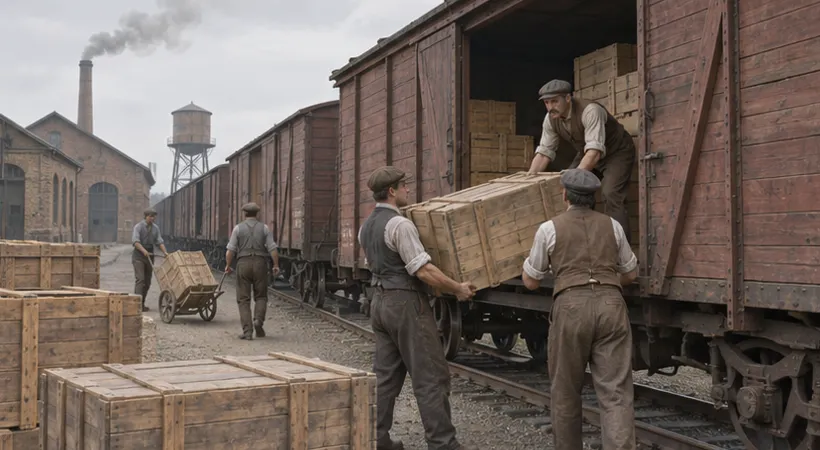
An army needed a steady supply of food, ammunition, uniforms, and replacements. Railways connected factories and ports to military depots, while ships brought supplies from overseas and exposed that trade to attack. When the war continued far longer than many leaders expected, governments had to organize labor and supplies for years. Households and industrial workers felt decisions made for military purposes through changes in prices, available food, work, and public messages. This connection between battlefield demands and civilian life is the starting point for understanding total war.
On much of the Western Front, defensive positions, artillery and machine guns made advancing costly. Trench warfare was a system of fighting from fortified lines, while stalemate describes the difficulty of achieving a decisive breakthrough. The war also extended across Eastern Europe, the Middle East, African colonies, and at sea. Geography and military conditions varied by theater.
Total war mobilized civilian resources for military objectives. Governments directed production and transport, recruited personnel, raised money, and rationed scarce goods. Propaganda sought to shape public attitudes and behavior. Colonial troops and workers joined war efforts, sometimes voluntarily and sometimes under coercive conditions.
Posters, production figures, and letters answer different questions. A poster shows the message authorities wished to spread. Records of production and testimony from workers give more direct evidence of how mobilization changed daily life.
A trench line was a military position, but maintaining it required factories, farms, transport workers, and civilians. Governments sought food and materials, regulated some economic activity, and tried to shape opinion. Colonial subjects also supplied labor and served in armies, so the war's demands reached beyond Europe. A propaganda poster documents the message officials wanted to spread, while ration records, payrolls, and letters can show how people actually lived with the demands. Those sources may disagree because households faced different shortages and choices.
- FrontFortifications and weapons shape movement and casualties.
- Home frontProduction, food, and labor are redirected.
- EmpireColonial labor and resources sustain fighting across regions.
A poster urging households to save food establishes a public message. Ration cards or official allotment records establish that restrictions were implemented. A diary can show how one household adapted, while broader records are needed to judge how common that experience was.
Try it
A poster urges citizens to buy war bonds. What does it show about total war? What can it tell you about actual public opinion?
Show sample response
It shows that the government sought civilian financing. To learn whether people supported the effort, compare the poster with purchase records, letters, or other evidence of responses.
U.S. entry, Russia’s exit & the armistice
What changed when the balance of forces shifted?
Germany fought major forces on both its eastern and western fronts, so a change in one theater could affect the other. Meanwhile, the United States had remained formally neutral for much of the war, even as American trade and lending connected it to the conflict. If a new country entered or an existing one withdrew, its military effect depended on timing. It took time to train, transport, and supply troops, and a government could redeploy forces faster than another could bring reinforcements into action.
Germany resumed unrestricted submarine warfare in 1917, placing merchant and passenger shipping at greater risk. Publication of the Zimmermann Telegram also strengthened support for U.S. entry. The United States declared war on Germany in April 1917 and contributed troops, supplies, and financial resources over time.
War losses and shortages intensified discontent in Russia. The February Revolution forced Tsar Nicholas II to abdicate. The provisional government continued fighting until the Bolsheviks seized power in the October Revolution, named for its date on the calendar Russia then used. The Bolsheviks negotiated the Treaty of Brest-Litovsk, which took Russia out of the war in 1918 and allowed Germany to shift forces west. Germany’s offensives failed to secure victory, and the Allies gained momentum before the armistice of November 11, 1918.
An armistice suspends fighting. A peace treaty establishes negotiated terms. The 1918 agreement stopping major hostilities and the Versailles peace treaty signed in 1919 therefore answer separate questions about how the war ended.
Russia's withdrawal and American entry did not take effect as mirror images. The Brest-Litovsk settlement freed Germany to move troops from the east, while newly arriving U.S. troops needed training, transport, and supplies before they could affect the Western Front. Germany's 1918 offensive took place amid those shifting pressures. The armistice later stopped fighting but did not itself settle borders or reparations. Tracking the months in order helps distinguish a military opportunity, a failed attempt to exploit it, and the later political settlement.
- April 1917The U.S. enters the war against Germany.
- March 1918Russia leaves the war through Brest-Litovsk.
- November 1918The armistice ends major fighting on the Western Front.
A wartime rail schedule showing German troop movements after Brest-Litovsk supports a claim about short-term military opportunity. It cannot alone explain why Germany failed to win. For that, compare evidence of supplies, battlefield losses, and Allied reinforcements.
Try it
Explain how Russia’s withdrawal and U.S. entry changed the military situation in different ways.
Show sample response
Russia’s exit let Germany shift forces from the Eastern Front. U.S. participation gave the Allies access to additional troops and resources as American forces arrived.
Versailles, borders & the League of Nations
Why did the victors want different kinds of peace?
French communities had experienced occupation and extensive destruction on the Western Front. French leaders wanted safeguards against another German attack. U.S. President Woodrow Wilson argued for a peace organized around international cooperation, including a League of Nations. Other delegates brought their own strategic and territorial priorities. At the same time, peoples seeking independence or greater autonomy had overlapping claims to some of the same regions. Keeping those goals in view helps explain why the peace agreements could address one group’s security concerns while leaving another group’s claims unresolved.
Delegates at Paris faced competing goals: prevent another war, address national claims, and determine what obligations Germany should bear. The Treaty of Versailles limited Germany’s military, assigned responsibility for losses as part of the reparations framework, and changed borders. Separate settlements addressed other defeated powers.
France had suffered invasion and extensive destruction and wanted safeguards against another German attack. British leaders had to weigh security, trade, and public demands for punishment. Woodrow Wilson promoted a League of Nations, but he could not promise that the U.S. Senate would ratify the settlement. These priorities overlapped without being identical. The treaty’s reparations provisions required Germany to compensate the Allies for damage; they did not constitute a single payment collected immediately in 1919.
Self-determination is the principle that peoples should have a say in their political status. Its application was selective. New borders created opportunities for some national movements, while minorities and many colonized peoples remained subject to governments they had not chosen. Former possessions were sometimes administered under the mandate system.
For example, the breakup of Austria-Hungary helped create Czechoslovakia, but German speakers and other minorities lived inside its borders. Former Ottoman territories in the Middle East came under British or French mandates. Calling a mandate temporary international supervision did not give residents the same power to choose their government that delegates claimed for some European peoples. Ask whose political voice a map includes before calling any boundary an example of self-determination.
The League of Nations aimed to organize collective security, cooperation to deter aggression. The United States did not join, and the organization depended on members’ willingness to act. Evaluating the peace requires separating policy intentions, institutional powers, enforcement, and long-term consequences.
A useful cause-and-effect claim needs more than the statement that Versailles caused World War II. Later economic crises, domestic political choices, and aggressive policies also mattered. The treaty supplied grievances that political leaders could exploit, while League responses to later aggression reveal how far collective security worked in practice. Compare the treaty text, debates over ratification, and records of later decisions before judging which link in that chain the evidence supports.
- SecurityMilitary limits respond to fears of renewed aggression.
- RepresentationRedrawn borders apply self-determination unevenly.
- CooperationCollective security depends on member action.
Suppose a peace map shows a new state alongside a large minority group inside its borders. The map supports the conclusion that some national claims gained recognition and others remained unresolved. The existence of a new boundary is only the start of the analysis.
Work through the evidence
A French delegate might favor limits on German forces because France had suffered invasion. A representative of a former imperial territory might instead ask whether the new borders allow self-government. The same settlement can be evaluated against both goals. Identify the provision first, then the group affected, before claiming that peace was fair or durable.
Try it
Choose one peace provision and explain both what a supporter hoped it would accomplish and one reason it might fail.
Show sample response
A supporter could argue that limiting Germany’s armed forces would reduce the immediate risk of another attack. The provision by itself could not guarantee cooperation or address every grievance created by the settlement.