
Enlightenment & Atlantic revolutions
What made these revolutions Atlantic?
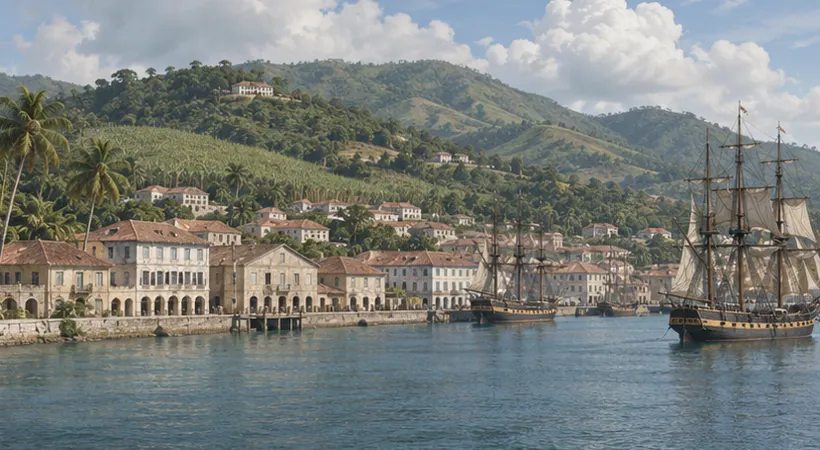
Ships carried books, newspapers, travelers, and political news between ports in Europe, the Caribbean, and mainland North America. Success in one place could give people in another a new language for making demands or a precedent for challenging rulers. The Atlantic also linked plantations, merchants, and systems of slavery. Those connections help explain why declarations of liberty could inspire people far from the place where they were written, while the people using those ideas faced very different laws, labor systems, and barriers to political participation.
Popular sovereignty locates political authority in the people or nation. Revolutionaries adapted this idea to different conflicts. In British North America, arguments over representation, rights, and imperial control developed into a demand for independence. In France, arguments over privilege and representation threatened the authority of the monarchy and changed the structure of government.
A declaration of rights states governing principles and claims about what people should be able to do. Its meaning in practice depends on laws, institutions, and who can exercise the rights it announces. Atlantic declarations drew on language about liberty and equality, even as political participation and personal freedom remained restricted in many places.
In Saint-Domingue, an economy based on enslaved labor made emancipation central to the struggle over political power. The spread of revolutionary claims did not produce a single Atlantic outcome. Comparison starts with the shared idea and explains how local conditions shaped its application.
Ports carried news and political arguments as well as goods. People in British North America protested a government across the ocean, while enslaved people in the Caribbean confronted plantation owners and colonial authorities closer to home. A shared phrase about liberty could therefore refer to different proposed changes. The author and audience of a declaration matter: whose authority did it challenge, who was included in its claim, and who still had to press for recognition? Comparing those answers reveals how ideas traveled without producing identical revolutions.
- British North AmericaColonists challenged imperial rule and declared independence.
- FranceRevolutionaries challenged inherited political and social privilege.
- Saint-DomingueEnslaved people fought for freedom in a slaveholding colony.
If two declarations promise liberty, that supports a claim about shared language. To compare their effects, examine who was able to vote, hold office, acquire legal freedom, or exercise civil rights under the laws that followed.
Try it
Name one shared idea and one difference between the American and French revolutions.
Show sample response
Both drew on consent and challenged inherited authority. The American Revolution broke ties with an empire, while the French Revolution changed the institutions of France itself.
French Revolution: estates, rights & terror
Why could taxation become a crisis of government?
The French monarchy faced heavy debts from wars, including its support for the American Revolution. Efforts to change taxation ran up against existing privileges and institutions that could resist reform. At the same time, poor harvests and rising bread prices made household budgets more precarious. A dispute that began with government revenue therefore reached people in very different ways. Officials worried about financing the state, while many households worried about buying food. The meeting called to address the fiscal crisis gave representatives an opportunity to raise both grievances.
Before 1789, the Old Regime organized French society into estates and granted distinctive privileges to clergy and nobles. Debt and efforts to raise revenue created pressure on the monarchy. When Louis XVI called the Estates-General, representatives disputed how votes should count, turning a financial crisis into a conflict over who could speak for the nation.
Third Estate representatives declared themselves the National Assembly. The Tennis Court Oath committed them to continue until France had a constitution. Popular action, disputes over property and taxation, and political organizing broadened the revolution. The Declaration of the Rights of Man and of the Citizen announced principles of liberty and legal equality.
External war, internal rebellion, and conflict among revolutionary groups intensified the struggle. During the Reign of Terror, officials used emergency laws and revolutionary tribunals against perceived enemies. This phase illustrates the tension between professed rights and the power claimed in the name of defending a revolution.
The financial crisis made decisions about taxation urgent, but the conflict also concerned who could speak for the nation. The Estates-General represented groups through an inherited structure that did not give every person an equal political voice. When representatives claimed to act as a National Assembly, they challenged that structure. A declaration of rights later stated broad principles, while political participation and the treatment of opponents changed as the revolution continued. Date a document before using it to describe the entire revolution.
- Revenue crisisThe monarchy convenes the Estates-General.
- Representation disputeThird Estate deputies claim authority as a national assembly.
- EscalationWar and internal conflict strengthen emergency government.
A tax chart can document inequality, while a record of assembly debates can show how that inequality became a dispute about political authority. Connecting the evidence explains the transition from grievances about taxes to demands for a constitution.
Work through the evidence
Work through two kinds of evidence: the 1789 declaration states a general principle of equal rights, while voting rules and membership records show who could exercise political power at a particular moment. A claim that the principle immediately applied equally to everyone needs both sets of records. Date them first: a later reform cannot prove what was possible in 1789.
Try it
Explain why a dispute over voting by estate could turn into a fight over who represented the nation.
Show sample response
If each estate had one vote, the clergy and nobility could outvote the Third Estate even though the Third represented most people. Claiming to represent the nation challenged the authority of the old voting system.
Haiti & Latin American independence
Which colonies were challenging which empires?
Saint-Domingue occupied the western part of Hispaniola, the Caribbean island now shared by Haiti and the Dominican Republic. Its plantations made it a valuable French colony. Spain governed extensive territories on the American mainland, where communities differed in social makeup, economic interests, and ties to colonial officials. Keeping the two imperial settings distinct helps explain why some revolutionaries focused on ending slavery as well as colonial rule, while many leaders elsewhere prioritized transferring political authority away from European-born officials.
French Saint-Domingue exported sugar and coffee from plantations sustained by enslaved labor. A large uprising began in 1791. Toussaint Louverture became a major leader as different groups and foreign powers struggled for control. France abolished slavery in its colonies in 1794, and Napoleon later sent an expedition to reassert French control.
Resistance continued after Toussaint’s capture. Haiti declared independence in 1804 under Jean-Jacques Dessalines. Emancipation, the ending of enslavement, was inseparable from the struggle over who would govern. Haiti’s victory challenged both the plantation system and the assumptions of slaveholding powers around the Atlantic.
In Spanish America, a crisis of legitimacy after Napoleon’s intervention in Spain opened opportunities for political movements. Creoles, people of European descent born in the Americas, often resented advantages held by peninsulares, officials or settlers born in Spain. Leaders including Simón Bolívar and José de San Martín helped defeat Spanish rule in different regions. Independence redistributed political authority, while many inequalities survived.
The social position of a person making a demand mattered. In Saint-Domingue, enslaved workers were fighting against a plantation system that denied their freedom, while some other Atlantic movements were led by people who already owned property or held local power. Independence could remove an overseas ruler without automatically settling who could vote, own land, or remain free. A constitution or declaration gives a formal goal; land and citizenship records can show how that goal changed people's lives.
- HaitiA revolution against slavery and French colonial rule creates an independent state.
- Spanish AmericaRegional movements defeat Spanish imperial rule and establish new governments.
- After independenceAsk which social and economic relationships changed and which endured.
For Haiti, evidence of new political borders alone would miss the destruction of the system of enslavement. For Spanish American regions, the proclamation of independence cannot by itself establish equal political access. Compare both the transfer of sovereignty and the changes in daily rights.
Try it
Explain why ending colonial rule and ending slavery were closely connected in Haiti.
Show sample response
Saint-Domingue’s plantation economy and French rule depended on enslaved labor. The revolution overturned both the institution of slavery there and French colonial authority.
Napoleon & the Congress of Vienna
What problem did the peace conference inherit?
For years, armies had moved through European states, rulers had lost thrones, and new political arrangements had replaced some older ones. When Napoleon’s power collapsed, diplomats had to decide which changes to preserve and which to reverse. They also had to rebuild working relationships among states that had fought together against him but had different goals for peace. The Congress of Vienna addressed security among governments. Questions about who should govern within those states and which national communities deserved their own institutions remained open.
Napoleon came to power during instability after the French Revolution. The Napoleonic Code unified significant parts of French civil law and secured some reforms associated with the revolution, including aspects of legal equality for men and protection of property. It also reinforced restrictions on women and existed alongside concentrated executive authority.
Military conquest spread French institutions and provoked resistance across Europe. Reforms, occupation, taxation, and warfare could affect the same population. A law’s influence and the political demands of imperial rule therefore need separate evidence and evaluation.
After Napoleon’s defeat, the Congress of Vienna reorganized Europe. Restoration returned some displaced dynasties, while the balance of power aimed to prevent any one state from dominating the others. Strengthening states near France served that strategic goal. Diplomats gave priority to stability, while demands for nationality and political participation remained unresolved. Later nineteenth-century nationalism helped drive movements for Italian and German unification and challenged empires that governed many peoples.
Napoleon's governments carried some revolutionary legal reforms into places reached by French armies, but military conquest also subjected communities to outside rule. After his defeat, diplomats at Vienna sought a balance among powerful states and the restoration of some ruling families. They could redraw borders without undoing every legal or social change people had experienced. A map before and after 1815 helps identify territorial decisions; a law code or local petition is better evidence for which institutional changes persisted.
- Legal changeA civil code retains some revolutionary reforms.
- Political powerNapoleon centralizes authority and expands through conquest.
- Peace settlementVienna restores rulers and redistributes power to limit domination.
Compare a provision of Napoleon’s civil code with a map from Vienna. The code addresses legal relations among individuals. The map addresses relations among states. Each can document change without resolving how representative the government was.
Try it
How might a person in a territory conquered by Napoleon see both change and continuity?
Show sample response
A civil code might replace some local privileges with standardized laws. Yet the territory could still lose political independence and be expected to support a powerful ruler’s wars.