
Renaissance, print & religious reform
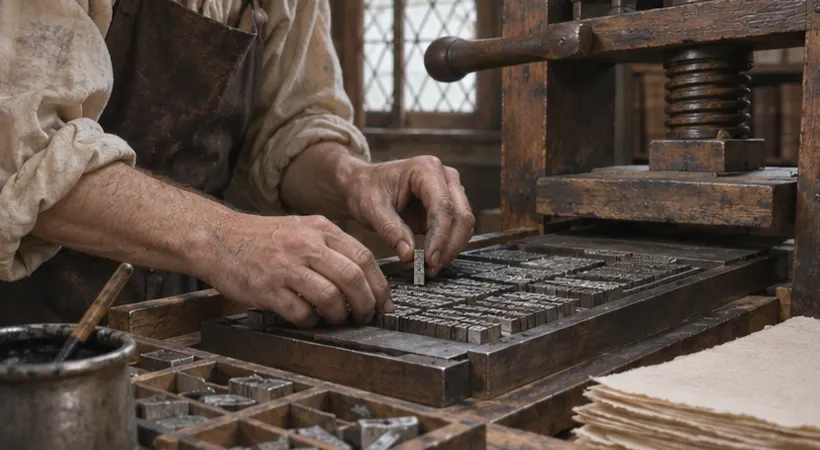
Who could share an idea before print?
Before European workshops widely adopted movable metal type, readers depended on handwritten copies and other forms of reproduction, including woodblock printing. Books took time and money to produce. Printing still required paper, skilled labor, and people willing to buy books, but a workshop could use the same arrangement of type to produce many copies. Print technologies also had a much older history in East Asia. The question for this chapter is what changed in Europe when merchants, scholars, and religious reformers could circulate arguments to readers they had never met.
Early modern Europe was part of an expanding system of trade and empire. The Columbian Exchange moved plants, animals, and pathogens across the Atlantic after 1492. American crops such as potatoes reached other continents. Epidemic disease devastated many Indigenous communities, and Atlantic commercial growth depended heavily on the forced labor and displacement of enslaved Africans. Global exchange created new connections while distributing gains and losses unequally.
The Renaissance encouraged scholars to study classical sources and compare manuscripts. Humanism emphasized language, history, and human action. Commercial printing with movable type made it easier to reproduce competing interpretations. Readers could compare texts across cities, although literacy, censorship, and access to books still shaped who joined the discussion.
During the Reformation, Martin Luther and other reformers questioned church practices and authority. Print helped their arguments travel, while rulers, clergy, and local communities determined how reform took hold. The Catholic Church also pursued internal renewal and responded to Protestant challenges. The technology explains the circulation of ideas. Political and religious choices help explain where institutions changed.
Printing changed the speed and scale of communication, but it did not make every idea equally available. A printer needed a market, authorities could censor a work, and many people still encountered arguments by hearing someone read aloud. At the same time, Atlantic exchange brought American crops into Afro-Eurasian food systems and introduced diseases to peoples in the Americas with devastating consequences. Those processes had different causes and effects. To explain early modern change, specify whether the evidence documents circulation of ideas, movement of goods, or the experience of a particular community.
- DevelopScholars or reformers advance a claim.
- CirculatePrinters and trade networks make copies available.
- RespondAuthorities and communities adopt, oppose, or regulate the idea.
Imagine that a pamphlet survives in three cities, but only one city changes its church administration. The copies are evidence that the argument circulated. To explain institutional change, compare records of local decisions and alliances in all three cities.
Try it
Explain how the same technology could help both religious reformers and their opponents.
Show sample response
A reformer could publish a criticism for people in several cities. Church officials or other writers could publish replies for those same audiences. Printing widened the debate.
Scientific models & evidence
Why was Earth’s place in the universe disputed?
To an observer standing on Earth, the Sun appears to cross the sky while the ground seems still. For centuries, astronomers used Earth-centered models that accounted for much of what people could see without telescopes. Astronomy also had practical value for calendars and navigation. The argument in the Scientific Revolution concerned which model could explain the evidence most consistently, including observations made possible by new instruments. Adoption happened over time as evidence, improved calculations, and new explanations of motion accumulated.
The geocentric model placed Earth at the center of the cosmos. Copernicus proposed a heliocentric model organized around the Sun. A new model mattered because it offered a different way to account for observations and predict future motion. Some observations challenged older claims while leaving more than one alternative possible.
Galileo used a telescope to observe moons orbiting Jupiter and phases of Venus. Jupiter’s moons demonstrated that at least some objects orbit a body other than Earth. Kepler used measurements of planetary motion to develop laws describing elliptical orbits. Newton later linked motion on Earth and in the heavens through a shared account of motion and universal gravitation.
In historical reasoning, separate an observation from an inference. An observation records what a person measured or saw. An inference explains what that record supports. Ask whether different researchers could repeat the observation and whether a rival model could account for it.
A proposed model had to account for observations that older models also tried to explain. Telescopic observations, mathematical predictions, and improved instruments contributed different kinds of evidence. Galileo's observations could challenge claims about an unchanging heaven, while Kepler's mathematical description of planetary orbits helped explain motion. Neither an instrument nor one observation alone settled every question. Readers should distinguish what an observer recorded from the broader explanation a scientist drew and from the reasons other scholars accepted or rejected it.
- ModelState how the system is thought to work.
- PredictionWork out what observers should find.
- EvidenceCompare the prediction with repeated measurements.
If two astronomers agree about the position of a planet but disagree on why it is there, they share an observation and dispute its explanation. A prediction on which their models differ would provide a stronger test than collecting a fact that both models already explain.
Try it
A new observation conflicts with an accepted model. Describe what a scientist should do before replacing the model.
Show sample response
Check whether the observation can be repeated and use both models to make predictions. Then compare how well each model explains the full set of evidence.
Enlightenment thinkers & rights
Why were thinkers questioning authority?
Conflicts over religion and government made questions about authority concrete. In seventeenth-century England, disputes between the Crown and Parliament led to civil war, the execution of Charles I, and eventually a restored monarchy. Hobbes wrote in the shadow of civil conflict. Locke’s political arguments emerged in a later period of disputes over royal power. Their different experiences help explain why security and limits on rulers could both seem urgent, even to thinkers who began with similar questions about why people form governments.
The Enlightenment used reasoned argument to question how institutions should work and what made authority legitimate. It included competing proposals. Social contract thinkers asked what arrangement people might accept to make life in a political community possible, and whether that arrangement imposed duties on governments as well as citizens.
Thomas Hobbes emphasized the need for an effective sovereign to maintain security. John Locke argued that legitimate government rested on consent and should protect natural rights, including life, liberty, and property. Jean-Jacques Rousseau asked how citizens could collectively make laws directed toward the common interest, which he described through the general will.
Montesquieu argued that distributing political power could help prevent abuse. Enlightenment arguments circulated widely, and later movements used them to demand changes in government. Their application was contested. Laws and political systems often excluded women, enslaved people, and others whose experiences tested claims about universal rights.
The arguments did not produce one shared plan for government. A thinker might defend freedom of conscience while another emphasized the need for order after civil conflict. Printed works circulated among educated readers, but access to literacy, publication, and political office remained unequal. When later revolutionaries borrowed the language of rights, they selected ideas that served different goals. Compare a writer's proposed limit on power with a later government's actual rule before calling the two positions identical.
- HobbesA strong common authority can reduce conflict.
- LockeConsent gives authority; government must protect rights.
- RousseauLegitimate law reflects the common interest of citizens.
A writer may defend a legislature because citizens authorize it, or because it limits the executive. Consent explains the source of authority. Separation of powers explains how authority is distributed. Identify which problem the writer is trying to solve before assigning an Enlightenment concept.
Try it
Compare what Hobbes and Locke feared most about political life and how that shaped their ideas about government.
Show sample response
Hobbes feared widespread insecurity without strong authority. Locke also wanted order, but stressed the danger of government violating rights and the people’s right to change a government that broke its trust.
Try it
Distinguish how divine right justifies a government from how consent justifies one.
Show sample response
Divine right treats political authority as granted by God to a ruler. Consent grounds government’s authority in the people who agree to be governed.