

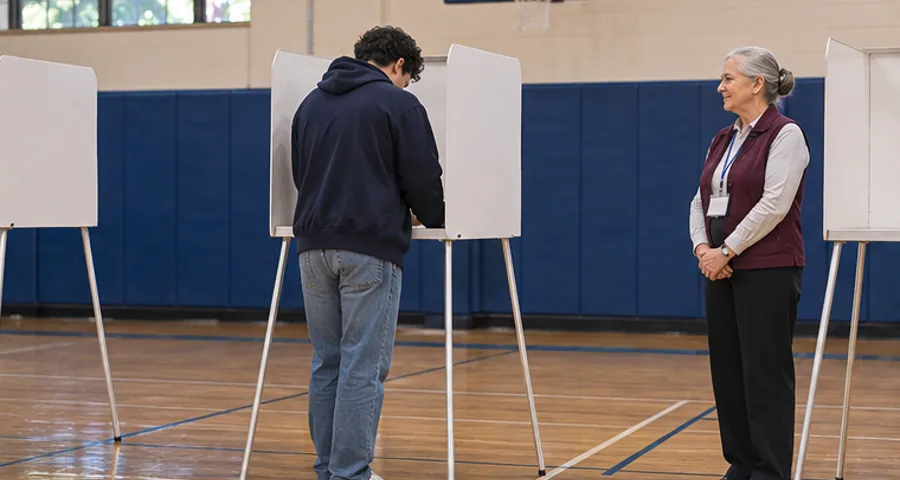
A high school senior turns 18 shortly before the November election. Campaign ads fill her phone, several candidates want her support, and a relative tells her that only presidential elections really matter. Before she can make an informed choice, she needs to understand who gets on the ballot, how campaigns influence voters, and how a vote becomes a political decision.
The electoral process connects popular sovereignty to the people who exercise government power. Citizens authorize representatives to make decisions about taxes, public services, rights, and national security. In the 2026 midterm election, voters chose members of Congress and many state and local officials. This is a midterm election year, halfway between presidential elections. The next regularly scheduled presidential election is in 2028.
Campaigns compete for attention and support
- SponsorWho paid for or published the claim?
- Sample and wordingWho answered, and what were they asked?
- InferenceDoes the evidence support a claim about all voters?
A campaign is an organized effort to win an election. Candidates recruit volunteers, meet voters, explain proposals, respond to criticism, and raise money. To endorse a candidate means to publicly express support for that person. An endorsement from a respected community member or organization can attract attention, but it is a recommendation, not an instruction voters must follow.
An incumbent currently holds the office being contested. Incumbents may benefit from name recognition, an established organization, and a record of constituent service. That record can also become a weakness when voters blame them for unpopular decisions. A challenger must explain both why change is needed and why that challenger deserves the job.
Campaign money comes with different rules
Campaigns pay for staff, advertising, travel, technology, and voter outreach. Funds may come from individuals, eligible political action committees, party committees, and candidates themselves, subject to the rules that apply. Hard money is money raised under campaign finance laws governing federal elections, including contributions directly to federal candidates. Those contributions have limits and disclosure requirements. For 2025–2026, an individual generally may give a federal candidate committee $3,500 per election; a primary and a general election count separately. State and local limits can differ. [1]
Historically, soft money meant nonfederal funds given to political parties for activities such as party building, outside federal contribution limits. The 2002 Bipartisan Campaign Reform Act barred national party committees from raising or spending this kind of soft money. It is outdated to say national parties can simply accept unlimited soft money to avoid federal rules. Some state and local nonfederal activity remains governed by separate rules. [2]
A Super PAC is different: it may accept unlimited contributions from permitted sources for independent spending, including ads supporting or opposing candidates. It cannot donate directly to federal candidates or coordinate its independent advertising with their campaigns. Money matters because it buys communication and organization, but more spending does not guarantee more votes. [1]
How candidates reach the ballot
Winning office usually requires two kinds of support: enough backing to become a candidate and enough votes to win the election. A nomination is the selection of a candidate to represent a party. Independent candidates seek office without a party nomination. Ballot access laws determine what candidates must do to appear on an official ballot.
The first step in the worksheet’s presidential selection diagram is self announcement: a person publicly declares an intention to run. That announcement does not automatically put a name on every state’s ballot. Candidates must satisfy the requirements for the relevant contest. Those rules can involve paperwork, deadlines, filing fees, petitions, and party requirements.
The three ballot access boxes in the diagram are pay a filing fee, collect petition signatures, and run as a write in candidate. A filing fee is a required payment where the law calls for one. A petition demonstrates support through signatures from qualified voters. A write in candidacy asks voters to enter a candidate’s name rather than select a printed name. These are not three steps every candidate completes in order. They represent possible methods, and the available methods depend on the jurisdiction. A petition is not always a substitute for a fee, and write in candidates may still have to file a declaration by a deadline.
Primaries and caucuses narrow the field
- NominationParties select their candidates under their rules.
- General electionVoters choose among the candidates on the ballot.
- CertificationOfficials verify totals under election law.
The next two boxes are party primary election and nominating caucus. A primary is an election in which voters help choose a party’s nominees. In a direct primary for an office such as governor, voters select the party’s candidate for that office. Presidential primaries usually help determine the delegates who will support candidates at the national convention. Delegates are representatives who participate in the party’s nomination process. [3]
A closed primary generally limits participation in a party’s nominating contest to voters affiliated with that party. An open primary generally allows voters to choose which party’s contest to enter, without requiring prior party registration. They do not vote in both parties’ contests for the same election. States also use systems that fall between these categories. Ohio voters do not choose a party when registering; they affiliate by requesting a party’s ballot in a partisan primary. [3, 4]
A caucus is a party meeting or party run process in which participants discuss candidates and express preferences. Depending on party rules, caucuses allocate national convention delegates directly or help select delegates through additional meetings. Primaries and caucuses give participating voters influence over which choices reach the general election. Early results can also affect donations, news coverage, and whether candidates remain in the race. [3]
The final box is the national party convention, where delegates formally nominate the party’s candidates for president and vice president. Candidates usually arrive with enough delegate support to make the result predictable. The convention also conducts party business and presents the party’s platform. This presidential process is relevant to 2028, not a presidential contest in 2026. [5]
Who participates and who stays home
Voter turnout measures participation in an election. Always check the denominator: the percentage of registered voters who vote is not the same as the percentage of all eligible voters who vote. People also participate by discussing issues, contacting officials, volunteering, and attending public meetings, but those activities do not replace casting a ballot.
Three reasons help explain why eligible people sometimes do not vote. First, apathy means a lack of interest or concern. Someone may pay little attention to politics or feel disconnected from public decisions. Second, disaffection means dissatisfaction or distrust. A person may dislike the candidates, distrust government, or believe officials ignore people like them. Third, low political efficacy means believing one’s participation will make little difference. A voter may assume a race is already decided or that one vote cannot matter.
These explanations overlap, but they are not identical. A person can care deeply about an issue while distrusting every candidate. Another person can trust elections but have little interest in the offices on the ballot. Practical barriers also matter: work schedules, transportation, caregiving, illness, language access, unfamiliar procedures, or a missed registration deadline can prevent someone who wants to participate from voting.
Voting requirements shape participation
- ProcedureCheck an official source for the location and deadline.
- EligibilityIdentify who may vote under applicable rules.
- ProtectionIdentify the amendment tied to the stated barrier.
For federal elections, voters must be U.S. citizens, meet age and state residency requirements, and follow applicable registration rules. In Ohio, a voter must be 18 on or before the general election and have lived in the state for at least 30 days immediately before the election. Registration generally must occur at least 30 days before Election Day, with deadline adjustments for Sundays and legal holidays. Certain legal disqualifications apply, including current incarceration for a felony, specified election law violations, or a probate court determination of incompetence to vote. [4]
Ohio also allows a registered 17 year old who will turn 18 by the general election to vote in primary contests that nominate candidates. That exception does not allow the student to vote on ballot issues or party central committee contests while still 17. This matters to high school students: eligibility depends on the election and the date of the eighteenth birthday, not simply grade level. [4]
Ohio requires an accepted, unexpired photo ID for ordinary in person voting. Examples include an Ohio driver license or state ID, a U.S. passport, and specified military or veterans IDs. A student ID is not an accepted substitute. Mail voting uses its own identification requirements. A voter facing an eligibility or ID problem may be able to cast a provisional ballot, which officials review before deciding whether it can be counted. [6]
Registration and identification procedures help officials verify eligibility and administer elections. They also require voters to know the rules and complete steps on time. Missing a deadline or lacking an accepted document can create a barrier. Online registration, registration assistance, accessible polling places, early voting, and absentee voting can help people participate. A useful analysis asks how a rule supports election administration and what it requires from an eligible voter.
Four influences on voter decisions
Party identification is a voter’s attachment to or preference for a political party. A party label gives voters a shortcut for anticipating a candidate’s general priorities. A voter may usually support one party but cross party lines when another consideration becomes more important.
Issues are the public problems and policy choices voters consider important. A voter focused on housing costs might evaluate proposals differently from one focused on abortion, immigration, education, health care, or taxes. Voters must also ask whether the office has authority over the proposed policy. A city council member cannot independently change federal immigration law.
The candidate’s background includes experience, record, judgment, integrity, personality, and character. Voters may examine an incumbent’s decisions, a challenger’s preparation, or either candidate’s ability to carry out a proposal. An appealing personality and a workable policy plan are different kinds of evidence.
The voter’s background includes experiences, family influences, age, religion, race, gender, income, education, and community. These may shape priorities and interpretations of events, but they do not determine every individual’s vote. People who share a background can reach very different political conclusions.
Different elections answer different questions
A general election is the regularly scheduled election in which voters choose the people who will hold office. A special election addresses a specific need, such as filling an unexpected vacancy or deciding a ballot issue. A special contest can sometimes occur on the same date as a regularly scheduled election; its purpose makes it special, not necessarily a separate day.
Many contests use a plurality rule: the candidate with more votes than any other candidate wins. A majority means more than half. If three candidates receive 45%, 35%, and 20%, the first has a plurality but not a majority. Some jurisdictions require a runoff or use other counting rules. Presidential elections ultimately depend on the Electoral College rather than a single nationwide popular vote total.
Election Day and private voting
Federal general Election Day is the Tuesday after the first Monday in November in even numbered years. It is not always the first Tuesday. In 2026, it was November 3. Ohio’s registration deadline for that election was October 5, and early in person and regular absentee voting began October 6. Ohio polling places are open 6:30 a.m. to 7:30 p.m. on Election Day. [7, 8]
A secret ballot allows a person to mark choices privately. It protects voters from pressure, retaliation, bribery, and intimidation. Officials verify who is eligible to vote while keeping the voter’s choices separate from identifying information. A public record that someone participated does not reveal which candidates that person selected. Privacy helps make the choice independent rather than something an employer, family member, or political group can control.
Voting before Election Day
An absentee ballot lets a voter participate without voting at the regular polling place on Election Day. A mailed ballot may be useful for someone attending college away from home, traveling, working a demanding schedule, managing a disability, or preferring to vote at home. States have different eligibility, identification, application, and return rules.
In Ohio, any registered voter with current information may vote absentee without giving an excuse. A voter requests a mailed ballot, completes it privately, supplies the required identification information, and returns it as instructed. For the November 3, 2026 general election, regular mail ballot applications must reach the board of elections by the close of business October 27. Ordinary absentee ballots must be received by 7:30 p.m. on November 3; a timely postmark alone is not enough. Separate rules apply to military and overseas voters. Ohio also offers early in person voting at designated locations. [9, 10]
What elections contribute to the public good
Elections offer two major public benefits. First, they provide public control and accountability. Citizens can approve an official’s record, choose different leadership, and influence the direction of policy through a peaceful process. Losing an election does not eliminate a person’s rights or end the opportunity to organize for the next one.
Second, campaigns can provide information and public debate. Competing candidates identify problems, propose solutions, and challenge each other’s claims. Voters can compare policies and decide which tradeoffs they accept. An election can bring attention to a neglected community concern and require candidates to explain what they would do about it.
Why campaigning also attracts criticism
One criticism concerns money and access. Fundraising requires time, and major donors or outside spenders may receive more attention than citizens with fewer resources. That does not prove every donation purchases a decision, but it raises questions about whose concerns candidates hear and how the public can evaluate influence.
A second criticism concerns misleading communication. Short ads, selective statistics, edited clips, and manipulated images or audio can leave out context. In a digital campaign, students should identify who paid for a message, inspect its evidence, and compare it with the full statement or official record. A widely shared claim is not necessarily an accurate one.
A third criticism concerns negative campaigning. Personal attacks and repeated accusations can distract from policy and deepen distrust. Criticism is not automatically harmful: a documented challenge to an official’s record can help voters judge performance. The question is whether a message offers relevant, supported information or mainly tries to provoke fear and hostility.
Return to the student preparing for her first election. She needs to verify her eligibility, learn which offices and issues are on her ballot, compare credible evidence, and choose a voting method that meets the deadlines. Understanding the process gives her a way to evaluate campaigns and exercise a share of governing power.
Apply the rules to a race
If three candidates receive 44%, 36%, and 20%, the first has a plurality because that candidate received the largest share. A majority would require more than 50%. To determine what happens next, apply the rule for that contest. A reported lead, a legally sufficient result, and official certification are separate conclusions. The same total can therefore support different conclusions depending on whether the contest uses a plurality or majority rule.
A campaign may cite a favorable poll without identifying the population sampled or the exact question. A survey of supporters can accurately describe those respondents while offering poor evidence about the electorate. Before deciding how much weight to give the finding, compare the population of interest with the sample and check how the questions were worded.
Sources
Bracketed numbers in the reading refer to these official sources, checked October 20, 2026.