
Ideas behind the Declaration of Independence
Background
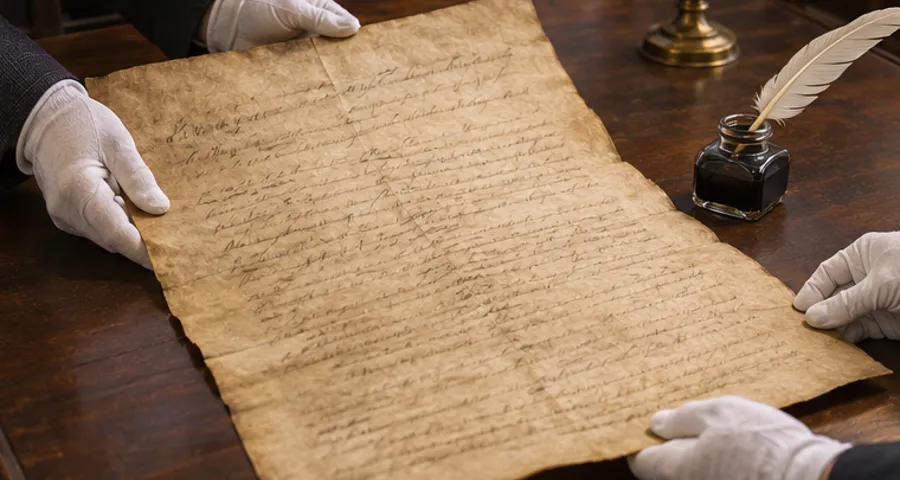
Before independence, many colonists argued within the British system, asking for changes to taxes, representation, or imperial policy. The Declaration changed the claim: the colonies asserted they were independent states and explained why separation was justified. Its statement of rights, list of grievances, and announcement of independence each perform a different job in the argument.
Natural rights are basic rights that people possess. The Declaration of Independence names life, liberty, and the pursuit of happiness and says governments are established to secure rights. Consent of the governed means legitimate power comes from the people. These ideas reflect a social contract, the idea that people accept government authority to gain protections and order.
The 1776 Declaration justified the colonies’ separation from Great Britain. Its list of grievances, or complaints, gave examples of how the authors believed the king’s government had violated their rights. The Declaration announced independence and explained why. The Constitution later established the structure and powers of the federal government.
The Declaration’s equality principle and political practice differed sharply. Slavery continued, women generally lacked voting rights, and Indigenous nations had their own political interests and governments. Later movements used the Declaration’s language to press the country to extend rights and participation.
- State a principlePeople have rights and government depends on their consent.
- Present evidenceDescribe actions the colonists viewed as abuses.
- Draw a conclusionAssert that the colonies may separate from Britain.
The Declaration moves from a principle to a justification for action. Its writers state that government draws legitimate power from the people, present grievances against the king, and use those grievances to justify independence. Distinguishing the claim from its evidence helps explain why the list of complaints is essential to the argument.
Explore the official source: National Archives: Declaration of Independence
Try it
Which part of the Declaration best explains where legitimate government power comes from?
Show sample response
Its principle of consent of the governed connects legitimate government authority to the people.
The Articles of Confederation and the Convention
Background
The states had recently fought against distant authority, so giving a national government limited powers seemed protective. The same design made it difficult to raise reliable revenue and coordinate policy among states. Delegates at the Constitutional Convention therefore faced two related tasks: making national action possible and keeping that power within limits.
Under the Articles of Confederation, states kept most governing power and sent delegates to a shared Congress. A confederation is an arrangement in which member governments keep substantial independence. Congress could conduct some national business, but it could not tax individuals directly and relied on state contributions.
Financial and enforcement problems pushed many leaders to seek changes. Shays’ Rebellion, a Massachusetts uprising tied to debt and taxes, added to some leaders’ fears about the country’s ability to respond to unrest. At the Constitutional Convention in 1787, delegates went beyond revising the Articles and drafted a new framework. The proposed Constitution strengthened the national government while retaining the states.
- ArticlesNational Congress depended heavily on state cooperation.
- ProblemRequests for money could leave shared obligations underfunded.
- ConstitutionCongress gained taxing power within a new system of limits.
Under the Articles of Confederation, Congress could request funds from the states. Its ability to pay shared obligations depended on whether states complied. The Constitution gave Congress power to levy federal taxes and divided national power among branches. That change addressed a practical revenue problem while raising a new question about how to restrain the government.
Explore the official source: National Archives: Articles of Confederation
Try it
Congress asks the states for money, but some do not send it. How does that example connect to the case for a new constitution?
Show sample response
Reliance on state contributions made federal revenue uncertain. The Constitution gave Congress power to tax directly within constitutional limits.
Representation and the founding compromises
Background
Delegates disagreed over who would gain power in the new national legislature. A large state could gain more seats through population, while a small state could protect its influence through equal votes. Disputes over slavery added another question: counting enslaved people increased the political power of states that enslaved them, even though those people did not get to choose representatives.
The Virginia Plan proposed representation tied to population or contributions and appealed to larger states. The New Jersey Plan favored equal state votes. The Great Compromise created a bicameral, or two-chamber, Congress. House seats are apportioned by population. Each state has equal representation in the Senate.
The Three-Fifths Compromise counted three-fifths of the enslaved population for representation and direct taxation under the original Constitution. Enslaved people gained no voting rights through this provision. Counting some of that population increased slaveholding states’ representation compared with counting none of it. The Fourteenth Amendment later replaced the original apportionment language.
- HouseRepresentation is apportioned by population.
- SenateEach state has two senators.
- CongressOrdinary bills must pass both chambers in identical form.
At the Convention, a state’s preferred rule often reflected its expected influence. Population-based representation favored more populous states. Equal representation gave smaller states an equal voice in one chamber. The resulting structure required agreement across both chambers. The separate Three-Fifths Compromise counted enslaved people toward representation without granting them political rights.
Try it
Which compromise answers a dispute about small and large states? Which answers a dispute about the population count under slavery?
Show sample response
The Great Compromise addressed representation by state and population. The Three-Fifths Compromise addressed how enslaved people would be counted for representation and direct taxation.
Ratification, the Constitution and the Bill of Rights
Background
The convention could propose a constitution, but the proposal still needed state approval. Debates played out through public writing and state conventions. Ratification and amendment were distinct actions: ratification put the original Constitution into effect, while the amendment process later made the Bill of Rights part of it.
To ratify means to give formal approval. Federalists favored ratification and argued that a stronger federal government could function while divided powers limited abuse. Anti-Federalists feared concentrated power and pressed for clearer protections for individual liberties. The Bill of Rights, the first ten amendments, was ratified in 1791.
The Preamble states purposes such as maintaining domestic tranquility, or peace within the country. The articles are the main sections that organize the framework. Articles I, II, and III cover Congress, the executive, and the federal courts. Article IV addresses relations among states. Article V sets out amendments. Article VI makes valid federal law supreme and forbids federal religious tests for office. Article VII explained how the original Constitution would take effect through ratification. Article II and the Twelfth Amendment also shape the Electoral College, the system in which appointed electors vote for president and vice president.
An amendment changes the Constitution. In the usual Article V route, two-thirds of each chamber proposes one and three-fourths of the states ratify it through the method Congress specifies. Article V also provides for a proposing convention called on application from two-thirds of state legislatures. Passing an ordinary law takes a different process.
- DebatePeople argue over power and explicit protections.
- RatifyState conventions decide whether to adopt the Constitution.
- AmendThe first ten amendments add explicit protections.
A Federalist could favor a stronger national government and still support restraints on its power. An Anti-Federalist could object to ratification without express protections while accepting the need for some shared government. Compare the particular risk each argument identifies. The Bill of Rights responded to concerns about protecting liberties under the new framework.
Try it
How would a Federalist and an Anti-Federalist explain different concerns about the same proposed national government?
Show sample response
A Federalist might stress that the national government needed power to act. An Anti-Federalist might stress that stronger power needed explicit limits to protect individual rights.
Constitutional principles in action
Background
A government can have separate offices while still allowing them to act on the same decision. For example, Congress passes a bill and the president can veto it. Separating their jobs describes the structure. Giving the president a veto describes a specific check. When analyzing a case, identify what one institution was allowed to do to affect another’s action.
Popular sovereignty means the people are the source of political power. Republicanism means that people govern through representatives. Majority rule gives weight to what most voters or lawmakers decide, while individual rights protect people even when they hold an unpopular view. Limited government means officials have only lawful authority. Under the rule of law, officials and ordinary people are subject to legal rules.
Separation of powers assigns different responsibilities. Congress makes federal laws, the executive carries them out, and courts resolve cases by applying law. Checks and balances give one branch a way to limit another, such as a presidential veto of a bill or a congressional override. Judicial review lets courts determine whether a law or government action conflicts with the Constitution in a case. Marbury v. Madison is a landmark example involving a federal law.
Due process requires government to follow fair legal procedures and respect applicable protections when it acts against someone’s life, liberty, or property. Think about the main action in a question. Giving Congress a job illustrates separation of powers. Giving Congress a way to respond to the president illustrates a check.
- Source of authorityPopular sovereignty asks where legitimate power comes from.
- Assignment of workSeparation of powers asks which branch acts.
- Restraint on actionChecks and balances asks who can limit another branch.
If Congress writes a law and an agency implements it, the example shows separation of powers through different assigned functions. If the president vetoes a bill or a court rules that a law violates the Constitution, the example shows one branch checking government action. Marbury v. Madison remains a case for studying judicial review before the separate courts chapter.
Try it
Congress makes law. The president vetoes a bill. Which example shows a branch’s assigned job and which shows a check?
Show sample response
Congress’s lawmaking responsibility shows separation of powers. The presidential veto shows a check on Congress.
Federalism, shared powers and the supremacy of valid federal law
Background
A person can follow city, state, and federal rules at the same time. Which level has authority depends on the subject and the legal source of the power. Education and licensing often begin at the state level, while spending, taxation, and regulation can involve multiple levels. Starting with the specific power helps prevent a blanket assumption about which government decides.
Federalism divides authority between national and state governments. Delegated powers are given to the national government. Expressed or enumerated powers are listed, such as Congress’s power to regulate commerce among the states. Implied powers are supported by those grants. Under the Necessary and Proper Clause, Congress can choose appropriate means to carry out its constitutional responsibilities.
Reserved powers remain with the states or the people under the Tenth Amendment, as long as the Constitution does not prohibit their exercise. Concurrent powers can be exercised by both levels, such as taxation. Interstate describes activity between states, while intrastate means within one state. The location of activity is a useful clue, but does not always decide which laws apply.
The Supremacy Clause means valid federal law prevails when it conflicts with state law. In McCulloch v. Maryland, the Supreme Court upheld Congress’s authority to set up a national bank and held that Maryland could not tax that federal instrument in the way at issue. The Full Faith and Credit Clause generally requires states to recognize other states’ public acts, records, and court proceedings, subject to legal rules. The Privileges and Immunities Clause limits certain discriminatory treatment of citizens of other states.
- NationalCongress can regulate interstate commerce.
- StateStates generally administer public schools.
- SharedBoth levels have taxing authority.
In McCulloch v. Maryland, Congress’s authority to create a national bank and Maryland’s attempt to tax it raised two distinct issues. The case linked implied powers to Congress’s enumerated responsibilities and explained limits on state interference with valid federal action. A strong explanation connects the legal rule to the specific action being challenged.
Try it
Both a state and the federal government collect income taxes. A state also tries to use a tax to undermine a valid federal institution. What changes between the examples?
Show sample response
The first shows concurrent taxing power. The second raises federal supremacy because the state’s exercise of power conflicts with valid federal authority.