
Reconstruction & the struggle over rights
Background
The federal government and former Confederate states faced choices about who could participate in political life after the Civil War. Freedom was legally transformative, yet people still needed access to jobs, education, safety, and ways to exercise political rights. This helps explain why historians use constitutional amendments alongside election records, local laws, and personal accounts rather than taking one kind of source as the whole story.
The Civil War destroyed slavery as a system of legally sanctioned ownership, but ending slavery left questions about citizenship, political power, labor, and access to land. Freedpeople formed families, built schools, organized churches, and pursued paid work and political office. White supremacist violence and opposition in government made those gains vulnerable.
The Thirteenth Amendment abolished slavery and involuntary servitude except as punishment after conviction. The Fourteenth established a national citizenship rule and required states to provide due process and equal protection. The Fifteenth barred voting denial based on race, color, or previous condition of servitude. Later segregation laws and voting barriers restricted participation. To explain Reconstruction’s legacy, compare constitutional text with records of who could exercise rights in practice.
The Freedmen’s Bureau helped administer assistance, including work involving schools and labor contracts. At the same time, many freedpeople faced pressure to accept arrangements that limited their economic choices, such as sharecropping under unfavorable terms. Political participation, education, and control over working conditions changed at different rates.
The amendments created national rules, but daily life depended on institutions that had to apply them. Freedpeople pursued family reunification, schooling, land, wages, and political voice, often at the same time. A local school record can show one kind of institution built after emancipation; an election record can show political participation; a labor contract can reveal economic bargaining power. Putting those records in order helps explain why a change in constitutional status did not produce equal opportunity everywhere at once.
- FreedomThe Thirteenth addressed enslavement.
- CitizenshipThe Fourteenth addressed citizenship and state treatment.
- VotingThe Fifteenth barred specified grounds for denial.
A photograph of a Black officeholder can document participation at a specific time. A later registration record might show exclusion. Using both supports a claim about change over time rather than assuming one source captures the whole period.
Work through the evidence
Imagine a county that elected Black officials in 1870 but rejected many Black voters twenty years later. The first record shows that participation was possible at one point; the second reveals a later barrier. To explain the change, compare the Fifteenth Amendment with local rules, enforcement records, and testimony. A constitutional protection and access in daily practice are related, but not identical.
Try it
State one achievement of Reconstruction and explain how a later example shows its limits.
Show sample response
The Fifteenth Amendment prohibited denying voting rights on the basis of race. Later, discriminatory literacy tests were used to keep many Black citizens from voting. The barrier shows the difference between a constitutional protection and its enforcement.
Western settlement & Native sovereignty
Background
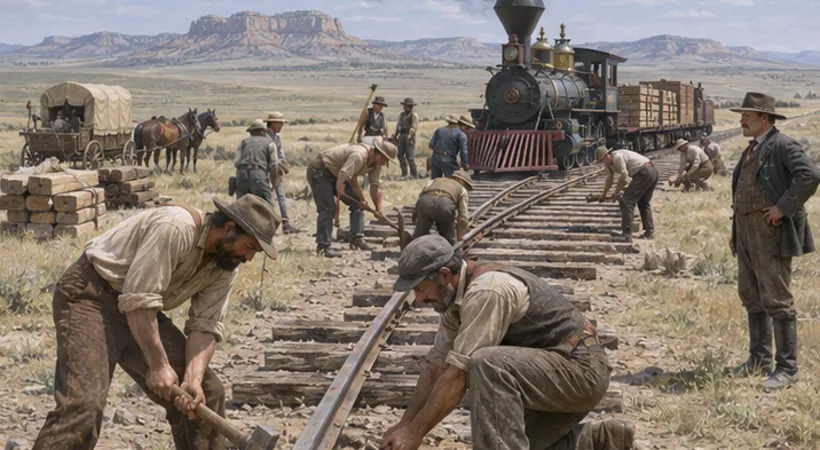
A railroad line can connect farming communities to distant markets while crossing land already used and governed by Native nations. An official survey, a settler’s letter, and a tribal treaty document different claims to the same place. Compare who could make legal decisions, who could move or trade more easily, and whose access to land changed.
Federal officials encouraged settlement and transportation on land that often overlapped Indigenous homelands. The Homestead Act provided a route to landownership for eligible claimants who met conditions such as living on and improving the land. Railroads reduced travel times and connected producers to markets, while military expansion and federal policy narrowed Native control over land and resources.
Many Native nations defended sovereignty, their authority to govern themselves. The Dawes Act divided many tribal lands into individual allotments, and other lands were opened to non-Native settlement. A map showing new farms can document settlement. To explain dispossession, examine the prior treaties, changes in ownership, and records of Native resistance or negotiation.
Railroad companies benefited from federal land grants in some cases. Communities near new routes could sell produce farther away, while families without nearby service had fewer transport options. Expanding commercial connections also accelerated pressure on Indigenous lands. The effects depended on where a line ran and whose prior claims were recognized.
A railroad route could make a farm's crops easier to sell and bring additional settlers into a region. The same route might cross territory governed or used by a Native nation under an existing treaty. Federal claim records show opportunities the government offered to eligible settlers, but they do not establish that the land had no prior residents or obligations. Compare a claim, a treaty, and a Native account to explain how settlement and dispossession could be linked without treating every nation or settler family as identical.
- ClaimantsCould qualify for land under federal rules.
- RailroadsConnected producers to buyers and brought more settlement.
- Native nationsFaced challenges to landholding and self-government.
Compare a settler’s application with a tribal treaty map. The first explains an opportunity under federal law. The second can show whose land claims and treaty rights were threatened by that opportunity.
Try it
Explain how the same land policy could appear to offer opportunity to one group and cause dispossession for another.
Show sample response
An eligible settler could gain a farm. Native communities could lose access to land or resources that had supported their economies and political independence. The groups experienced the policy from different positions of power.
Industrial growth, technology & big business
Background
A factory owner who can ship to a national market has reason to invest in machinery and produce larger quantities. If a firm also buys its rivals or controls important suppliers, the shift affects who sets prices and terms. Historians can study production and competition separately, then ask whether a particular business arrangement changed both.
Industrial growth depended on a combination of workers, investment, raw materials, transportation, and inventions. Rail lines linked factories to national markets, while electrical power and specialized machinery increased what firms could produce. Business leaders also reorganized ownership, using arrangements such as trusts and mergers to coordinate several firms.
Consolidation could lower some production costs while reducing the number of competitors. A company that controlled a market could influence prices, output, or access to suppliers. Antitrust policy responded to restraints on competition, including conduct targeted by the Sherman Antitrust Act of 1890. A historian evaluating an industry should compare market share, prices, and business practices rather than assuming all large firms operated in the same way.
Steel and oil illustrate different ways firms expanded. Steel production could be coordinated with access to fuel, ore, and transportation. Oil refiners could gain influence by acquiring rivals or securing favorable freight rates. Those details help explain how business size, control of a supply chain, and power over competitors can be related.
A railroad connection could make a factory more productive by lowering shipping time and opening distant markets. A merger could also change who controlled that market. Those developments might occur together, but neither proves the other: a firm can grow through innovation without acquiring rivals, and a merger can restrict alternatives without improving a product. To evaluate a business's impact, separate output, prices, working conditions, and ownership. Each calls for different records and may lead to a different conclusion.
- TechnologyMachines and transport can increase output.
- ConsolidationFirms combine control of production or distribution.
- AntitrustGovernment can challenge restraints on competition.
A factory payroll can show changes in employment after expansion. It cannot by itself establish whether the company blocked rivals. Market-share figures and supply contracts would address the competition question.
Try it
Explain how business consolidation can produce both lower production costs and concerns for customers.
Show sample response
A larger company may spread costs over more production and coordinate supply. If rivals disappear, consumers may have few alternatives and the firm may have greater power over price and service.
Labor organizing & Populism
Background
A factory worker and a small farmer might both feel they had little influence over the terms on which they earned a living. Their counterparties differed: one negotiated with an employer, while the other dealt with lenders, buyers, and freight companies. Compare the institution each group could pressure and the form of organization it used.
Many workers depended on wages set by large employers. A union could combine workers’ demands through collective bargaining or withhold labor through a strike. Success depended on participation, management’s bargaining position, and the response of officials or courts.
Farm families often faced debts, changes in crop prices, and dependence on rail freight decisions. Farmers organized cooperatives and political movements. The People’s Party, often called the Populists, called for changes such as railroad regulation and a more expansive currency. Workers and farmers both sought leverage, but collective action in a workplace and a campaign to change national policy used different tools.
Who can continue without the other side’s cooperation affects bargaining power. Employers might try to hire replacement workers, and workers could try to recruit enough participants to stop production. Farmers working alone had little influence over freight charges, while a political movement could seek rules that applied to carriers across many communities.
A factory employer could set hours or wages for many employees, while a railroad could set freight charges that affected farmers along its route. Workers used unions and strikes to increase bargaining power with an employer. Farmers could join cooperatives or support political regulation of carriers and credit. Both responses depended on organization, but they addressed different institutions. A strike notice records a demand; a later contract or law shows whether terms actually changed. Compare goals with outcomes before calling an effort successful.
- WorkersBargain together or stop work.
- FarmersOrganize cooperatives and voters.
- GovernmentCan shape labor rules, shipping, or currency policy.
A union contract can show that management agreed to change hours. A party platform shows which policies reformers wanted. To test whether either strategy worked, look for what decision-makers actually did.
Try it
Compare a factory union’s strategy with a Populist farmer’s strategy. Explain how each sought more bargaining power.
Show sample response
Workers could stop work together to pressure an employer. Farmers could organize voters to press legislators for railroad regulation. Both used collective action, through different institutions.